How ChatGPT Understands Your Questions (Explained with One Piece & Naruto)
An LLM is basically Nico Robin who learned ninjutsu — here's how it actually works.

How ChatGPT Understands Your Questions
You type a question. A few seconds later, a clear answer shows up. It feels like the computer just gets you.
But it's not magic. There's a simple set of steps happening behind the scenes, and once you see them, the whole thing stops feeling mysterious.
I'm going to explain it using One Piece and Naruto, because honestly, the ideas are easier to remember when they're tied to characters doing cool stuff. And don't worry if you've never watched a single episode. Read the next section and you'll be caught up in two minutes.
First, Meet the Cast (skip this if you already watch anime)
These are the characters and ideas I'll use as examples. That's all you need to know.
From One Piece:
Luffy — the main hero. Fun, loud, and totally unpredictable in a fight. He makes things up as he goes.
Nico Robin — the super-smart one. As a kid she read a whole island's worth of books, so she knows a little about everything.
Zoro — a swordsman on the crew. Just remember he carries swords.
Observation Haki — a special "sixth sense" some characters have. It lets them feel everything happening around them at once, like a radar, instead of looking at one thing at a time.
Poneglyphs — ancient stones covered in writing that almost nobody can read. To most people they're just weird symbols.
From Naruto:
Hand signs — ninjas make a series of hand shapes (in a set order) to cast a move. Different order of signs = different move.
Jutsu — the move itself, like throwing a fireball.
Itachi — a calm, super-controlled genius. Everything he does is careful and exact.
That's the whole cast. Now let's get into it.
The Big Picture
Here's the journey your question takes, start to finish. We'll unpack each part below.
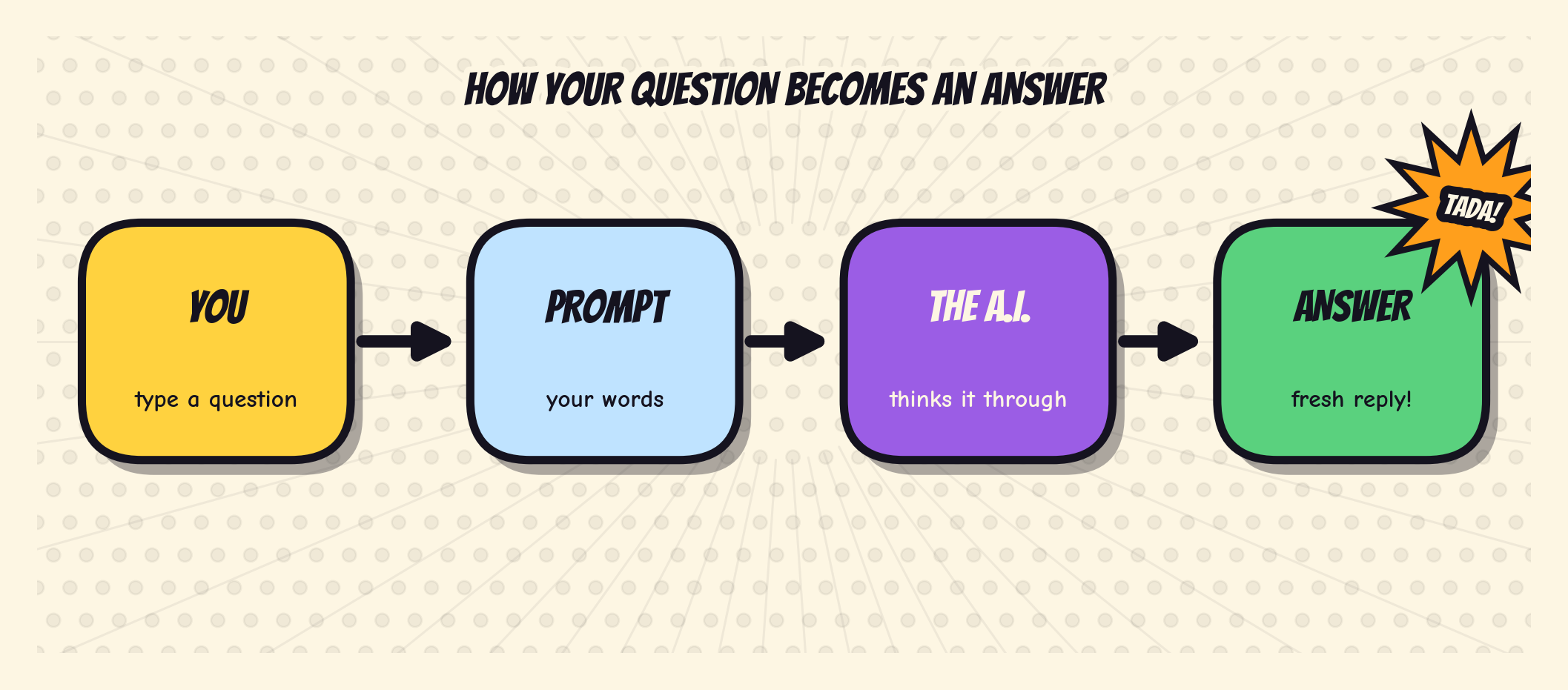
By the end, that "A.I." box in the middle won't be a mystery anymore.
1. What Is an LLM?
ChatGPT is something called an LLM. That stands for Large Language Model. Let's break the three words down:
Large — it learned from a huge pile of text. Books, websites, articles, conversations.
Language — its whole job is working with human words.
Model — it's a system that found patterns in all that text.
Think of it like Nico Robin
Remember Robin, who read a whole island of books as a kid? An LLM is kind of like that. It "read" a giant chunk of the internet, and from all that reading it picked up patterns: how words fit together, how a question usually leads to an answer, how to explain things.
Here's the key part: it didn't memorize the pages. It learned the patterns. So when you ask it something, it's not flipping back to a page it saved. It's working out an answer from everything it learned. Same way Robin can figure out history from a few clues, instead of having the exact answer written down somewhere.
What is it actually good for?
Plenty of everyday stuff:
Answering questions in plain words
Making long things shorter (summaries)
Translating between languages
Writing and explaining code
Helping you write emails, essays, and stories
Just chatting back and forth
Ones you might've heard of
ChatGPT (by OpenAI), Claude (by Anthropic), Gemini (by Google), and Llama (by Meta) are some of the big names.
And you probably already use this tech without thinking about it: the autocomplete in your email, the chatbot on a shopping site, the code helper in a coding app. It's everywhere now.
2. What Happens When You Hit Send?
Sending a message to ChatGPT is a lot like a ninja casting a jutsu.
In Naruto, you can't just think "fireball" and have flames appear. You make the hand signs first, in the right order, and then the move happens. ChatGPT works in steps too.
Here's the flow:
You type your question. This is your input. Just like the order of hand signs decides which jutsu you get, the way you word your question shapes the answer. "Explain this like I'm five" and "Explain this for an expert" give very different replies.
The computer reads your message. It chops your words into small pieces and turns them into numbers (more on that soon).
It builds the answer one piece at a time. This is the surprising bit. ChatGPT doesn't write the whole reply at once. It guesses the next word, then the next, then the next, like building something up bit by bit.
The answer shows up on your screen.
Why the answer isn't just copied from the internet
This is the part people get wrong, so it's worth being clear about.
ChatGPT is not searching a giant folder and pasting a saved answer.
Think of it this way. When some ninjas copy a move they've seen, they're just repeating a move that already exists. ChatGPT doesn't do that. It's more like a fighter who watched thousands of battles and now invents a brand-new combo on the spot, made to fit this exact moment.
That's why you can ask it something nobody has ever asked before, like "explain how computers work using a pizza shop," and it can still give you a fresh, sensible answer. It's making the answer, not copying it.
3. Why Computers Don't Actually "Read" Words
Here's something weird but true: the computer has no idea what your words mean. None at all.
To you, a word like "friend" carries a feeling. To a computer, letters are just shapes on a screen. A computer can't think about what words mean. The only thing it's really good at is math — adding and multiplying numbers, super fast.
The Poneglyph problem
Remember the Poneglyphs, those ancient stones covered in writing that almost nobody can read? To most people they're just meaningless symbols. You'd need to first turn them into a language you actually understand.
Words are like Poneglyphs to a computer. Before it can do anything useful, your words have to be turned into numbers — the one thing it can work with.
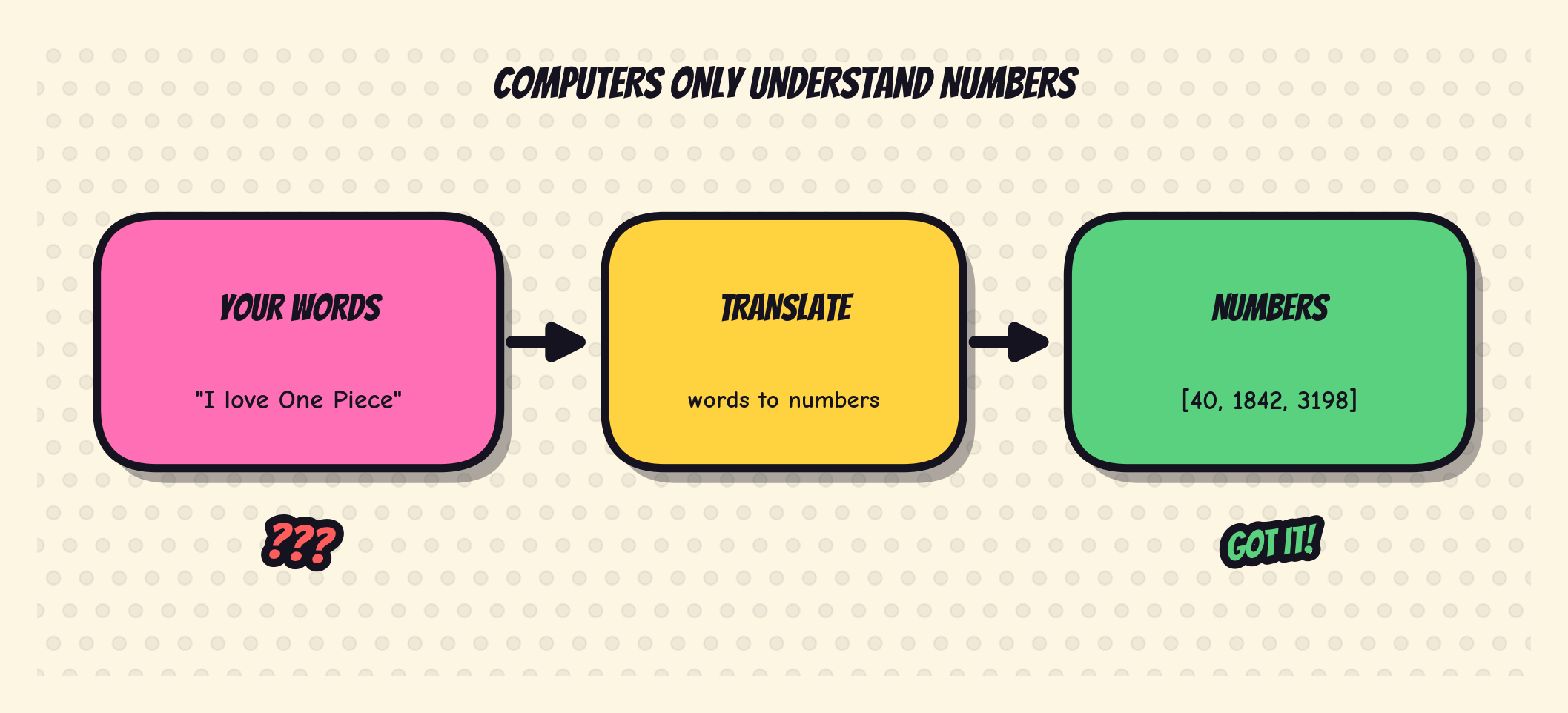
So step one is always the same: turn the words into numbers. And to do that, we need tokens.
4. Tokens (Breaking Words Into Pieces)
Before your words become numbers, they get chopped into small pieces. Each piece is called a token, and the chopping is called tokenization.
The hand-sign idea
In Naruto, a jutsu isn't one single action. It's a sequence of hand signs done in order. Each sign is a small piece, and stringing them together makes the move.
Tokens are the hand signs of language. The computer doesn't swallow a whole sentence in one bite. It reads a string of small pieces, one after another.
So what's a token?
A token is just a chunk of text. It might be:
a whole word, like
dragonpart of a word, like
token+izationa single symbol, like
!
Words and tokens aren't the same thing
This surprises people. One word can be split into a few tokens, while short common words are usually just one. Here's the idea:
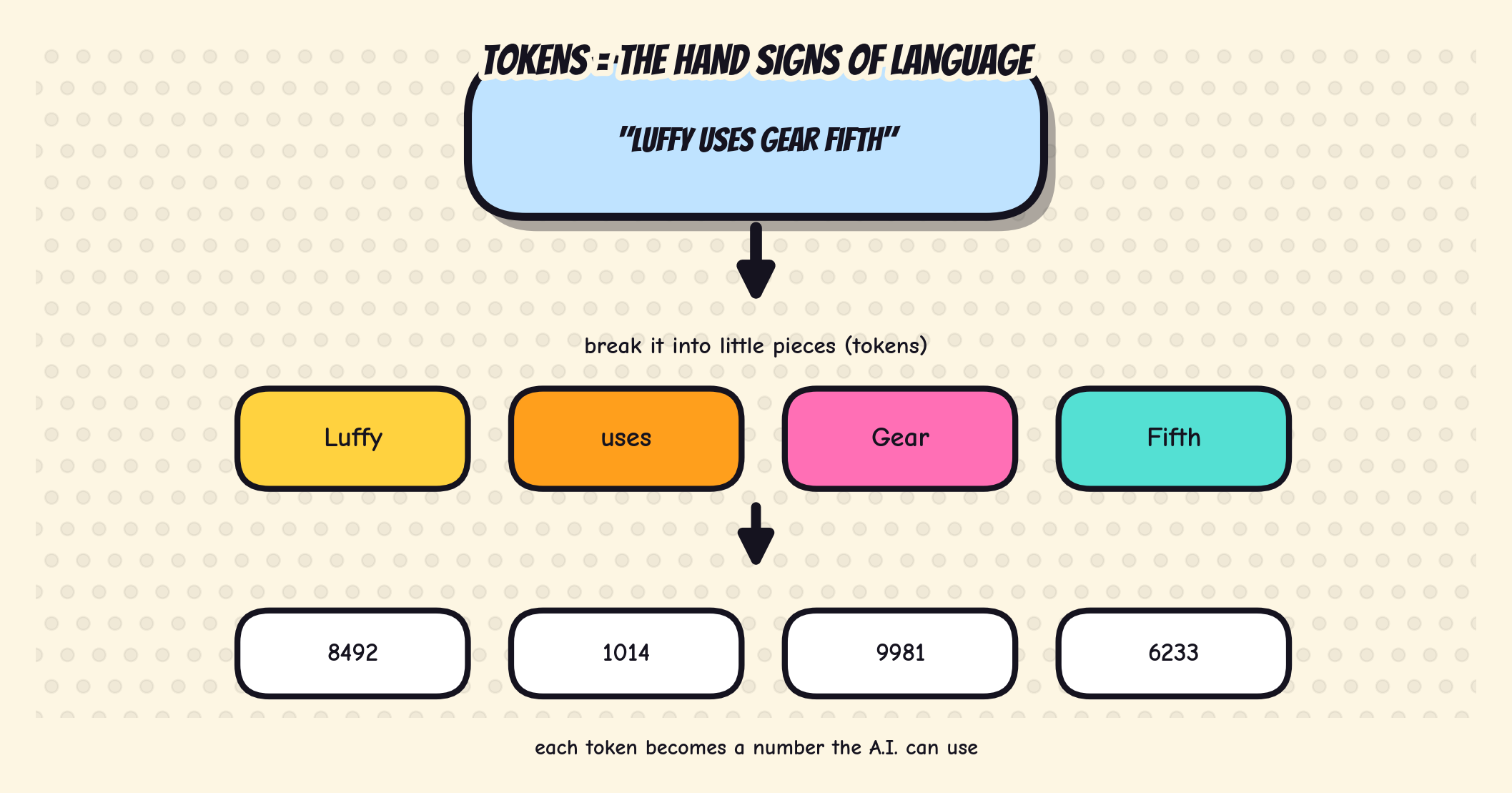
A rough rule for English: one token is about four letters, or roughly three-quarters of a word.
Why bother chopping at all?
Two reasons:
You can build anything from small pieces. A handful of hand signs can make hundreds of jutsu. In the same way, a few thousand tokens can build any word, even made-up ones. The computer doesn't need to have seen a word before; it just needs the pieces.
Each piece gets a number. Every token has its own ID number. Once your sentence is a list of numbers, the computer can finally start doing its math.
So tokens are the bridge from "weird symbols" to "numbers the computer can use." But numbers alone don't add up to understanding. For that, we need the real star of the show.
5. Transformers (The Real Game-Changer)
The Transformer is the clever design that powers nearly every modern AI like ChatGPT. It showed up in 2017 and it's the main reason AI suddenly got so good at language. (Fun fact: the "T" in ChatGPT stands for Transformer.)
Its superpower: paying attention to everything at once
Older AI read text slowly, one word at a time, left to right. The problem? By the time it reached the end of a long sentence, it had half-forgotten the start. It struggled to connect words that were far apart.
The Transformer fixed this with something called attention. And the best way to picture attention is Observation Haki from One Piece.
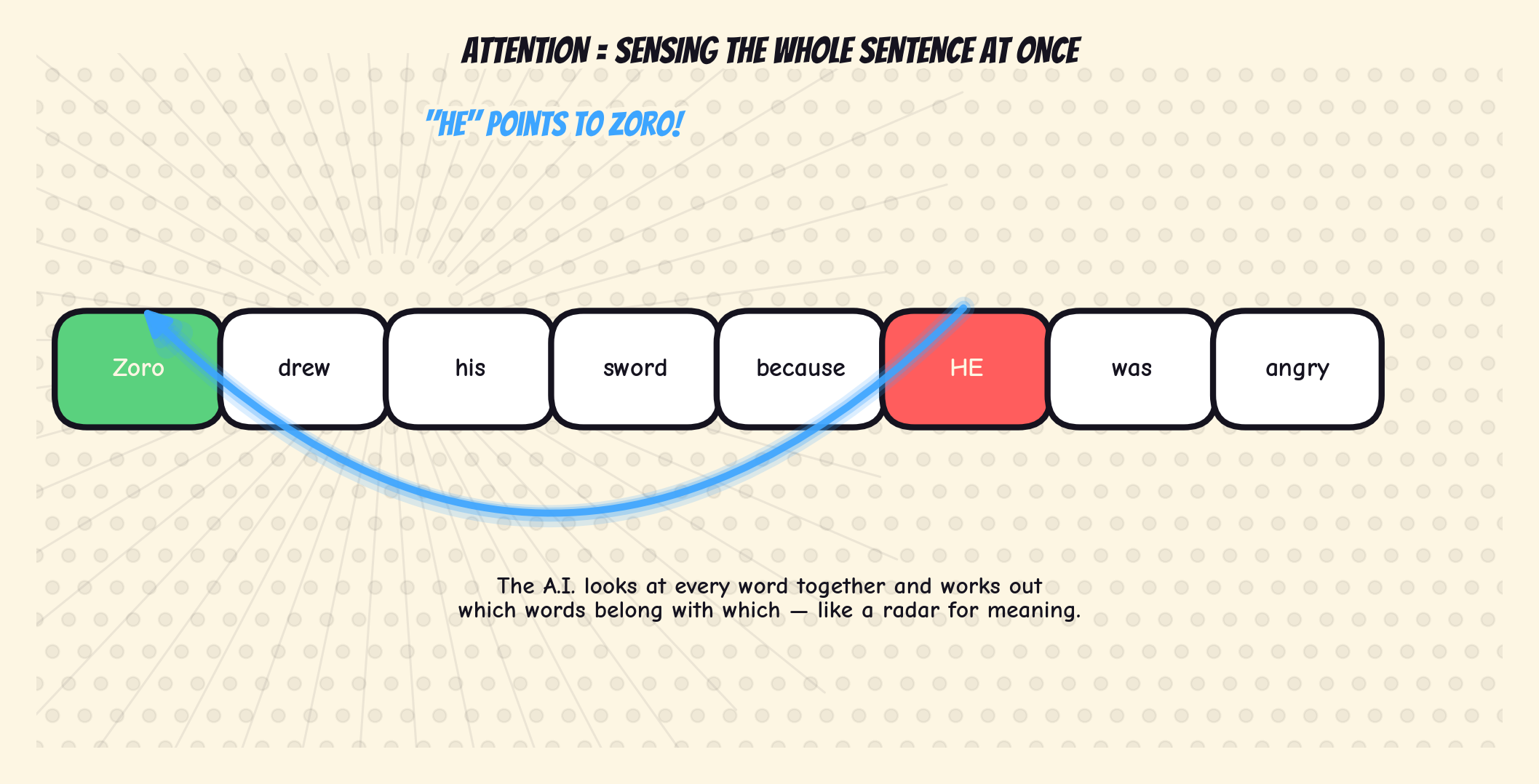
A Haki user doesn't stare at one enemy. They sense the whole area at once and feel how everything connects. That's exactly what a Transformer does. For every word, it looks at all the other words at the same time and figures out which ones matter most.
Take this sentence: "Zoro drew his sword because he was angry."
To understand who "he" is, the Transformer scans the whole sentence and locks onto "Zoro." It senses the connection, just like Haki senses which presence matters in a fight.
Why this changed everything
Because it looks at all the words together instead of one by one, the Transformer is faster, smarter about long sentences, and it scales up really well. More text to learn from means more patterns, which means a smarter AI. That loop is what took us from clumsy chatbots to the ChatGPT we have today.
This is why basically every big AI model uses Transformers now. It just works better than anything before it.
Two Bonus Ideas You'll Hear A Lot
These come up constantly, and both are easy with anime.
The Context Window (the AI's short-term memory)
A Transformer can only pay attention to so many words at once. That limit is called the context window. Think of it as how much the AI can hold in its head at one time.
Picture a fighter who's amazing but only has so much energy before they run out. The AI is similar. It can keep a certain amount of your conversation in mind, but once you go past the limit, the earliest stuff starts slipping away.
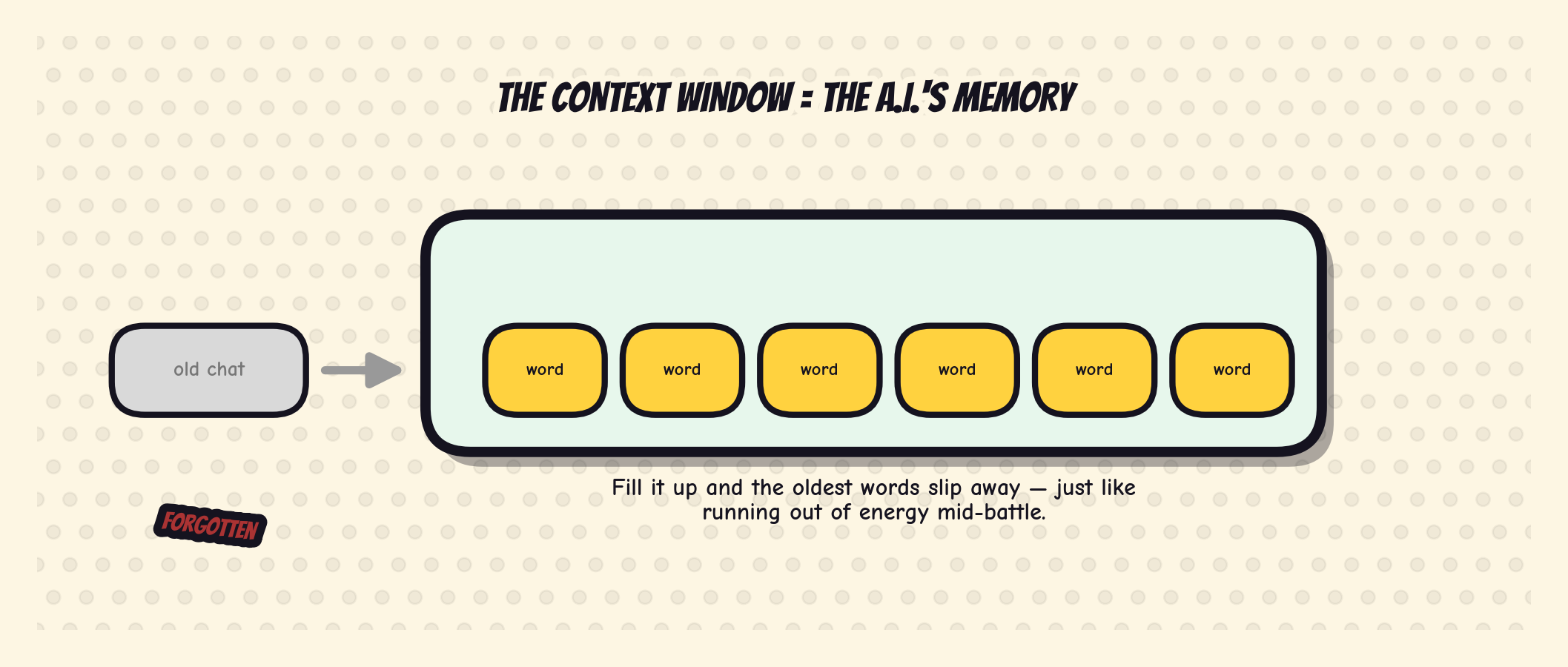
A bigger context window just means it can remember more of your chat, document, or code at once.
Temperature (calm vs. wild)
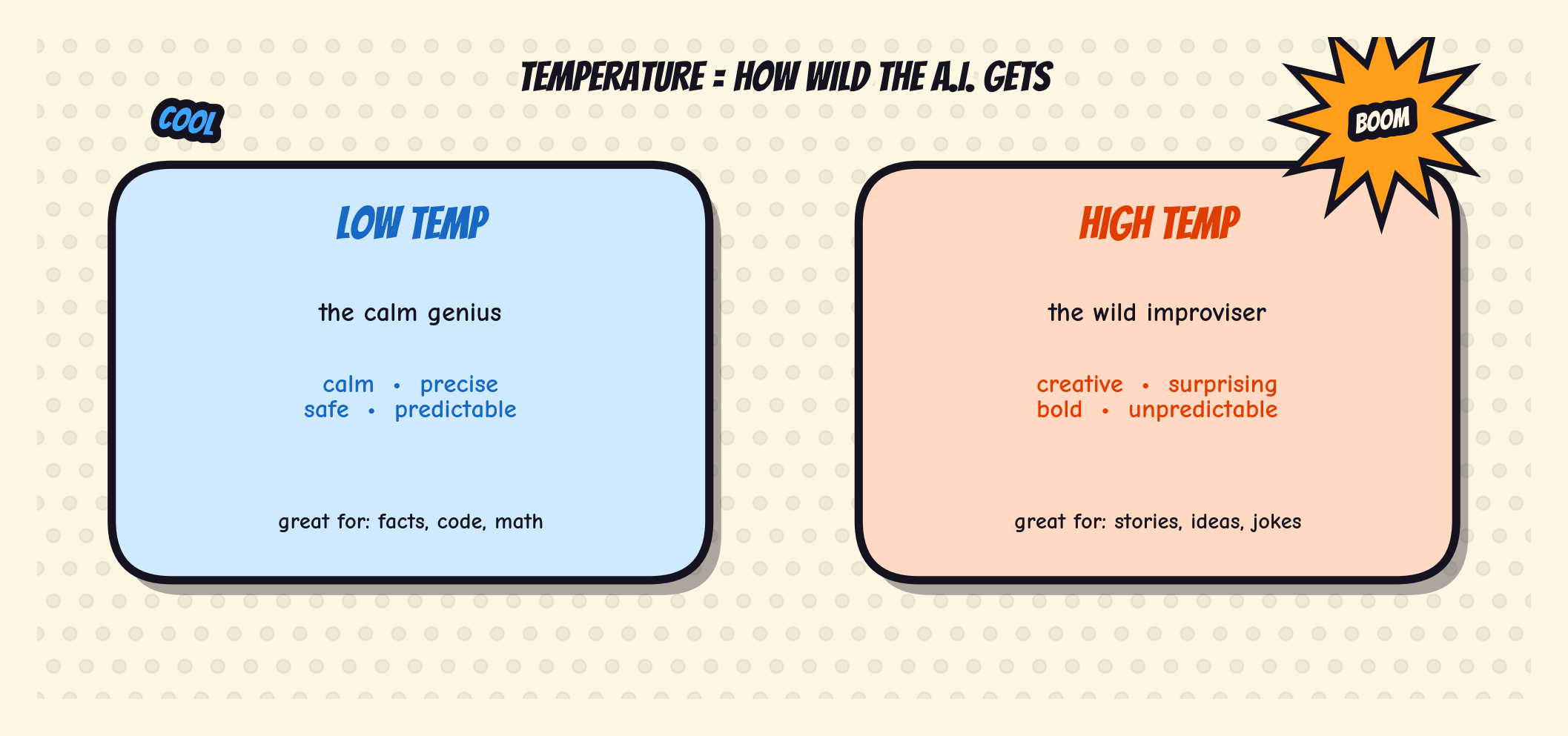
Temperature is a setting that controls how predictable or creative the AI is.
Low temperature is the careful, by-the-book mode. Think Itachi: calm, exact, no surprises. Great for facts, math, and code.
High temperature is the wild, surprising mode. Think Luffy: making it up as he goes, bold and unexpected. Great for stories, brainstorming, and jokes.
If you ever write code that talks to an AI (hello, GenAI with JS!), this is literally one setting you can change:
// Asking an AI from JavaScript
const response = await client.chat.completions.create({
  model: "gpt-4o",
  temperature: 0.2, // calm & precise (Itachi mode)
  // temperature: 1.0, // creative & wild (Luffy mode)
  messages: [
    { role: "user", content: "Explain tokens using Naruto." }
  ],
});

console.log(response.choices[0].message.content);
Same question, one number changed, totally different vibe in the answer.
Putting It All Together
Here's the full journey your question takes, top to bottom:
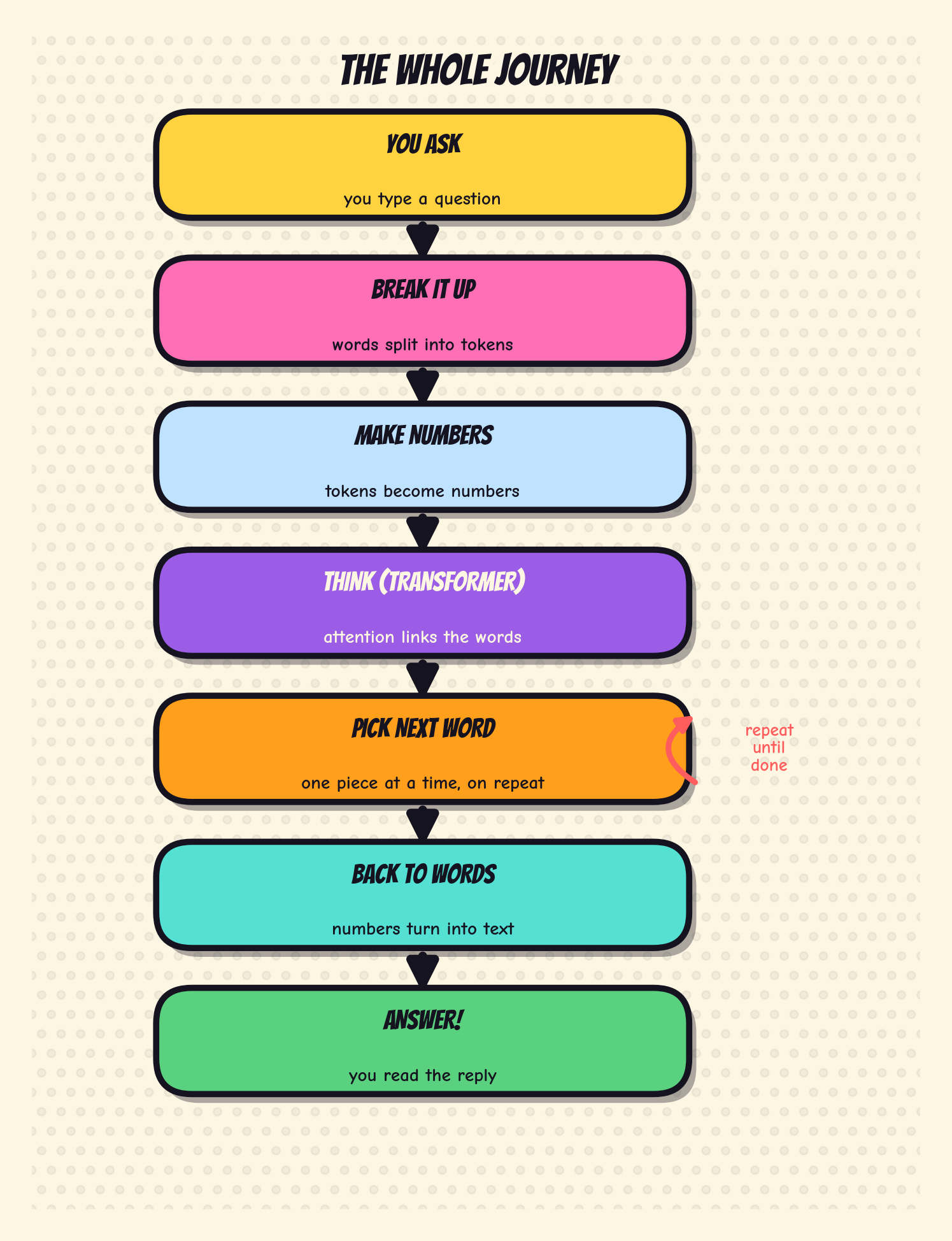
That's it. That's the whole "magic."
The Super-Short Version
If you remember nothing else, remember this:
An LLM is like Nico Robin who read the internet. It learned patterns, it didn't memorize pages.
Sending a message is like casting a jutsu. The answer is built fresh, never copied.
Computers only understand numbers, so your words get turned into numbers first.
Tokens are the hand signs of language: small pieces that combine into anything.
Transformers use attention, like Observation Haki, to look at the whole sentence at once. That's the big reason they understand you so well.
Context window is the AI's memory limit. Temperature is calm Itachi vs. wild Luffy.
So next time ChatGPT nails your question, you'll know the truth. It's not reading your mind. It's chopping your words into pieces, turning them into numbers, sensing how everything connects, and building an answer one word at a time.
Pretty cool for a bunch of math.
Play With It Yourself 🔧
Don't just take my word for it. These free tools let you poke at every idea in this post:
Transformer Explainer — a real mini-GPT in your browser. Covers tokens, attention, and the temperature slider all in one. Start here.
Tiktokenizer — see any text split into tokens, live.
Embedding Projector — watch words with similar meanings cluster together in space.
Bycroft's LLM Visualization — a 3D fly-through of an entire GPT, start to finish.
If this helped it click for you, tell me your favorite anime-to-tech comparison in the comments. I'm collecting good ones for the next post.
Comments
Join the discussionNo comments yet. Be the first to comment.